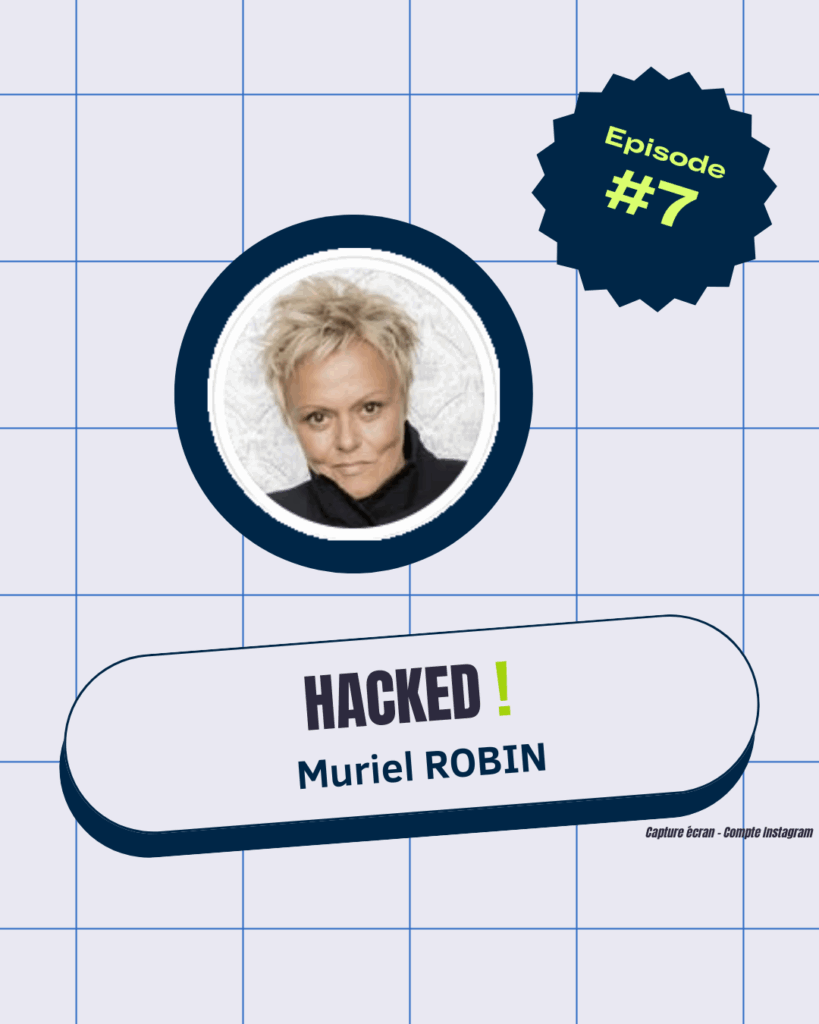
Hacked! – Episode #7
Muriel Robin, comedian, humorist, César-winning actress, committed activist, her public image has been built over decades of artistic work and public stances. It is this accumulated credibility, this familiarity that millions of French people have with her, that criminal networks decided to exploit by creating deepfakes in her likeness to promote financial scams and fake health remedies.
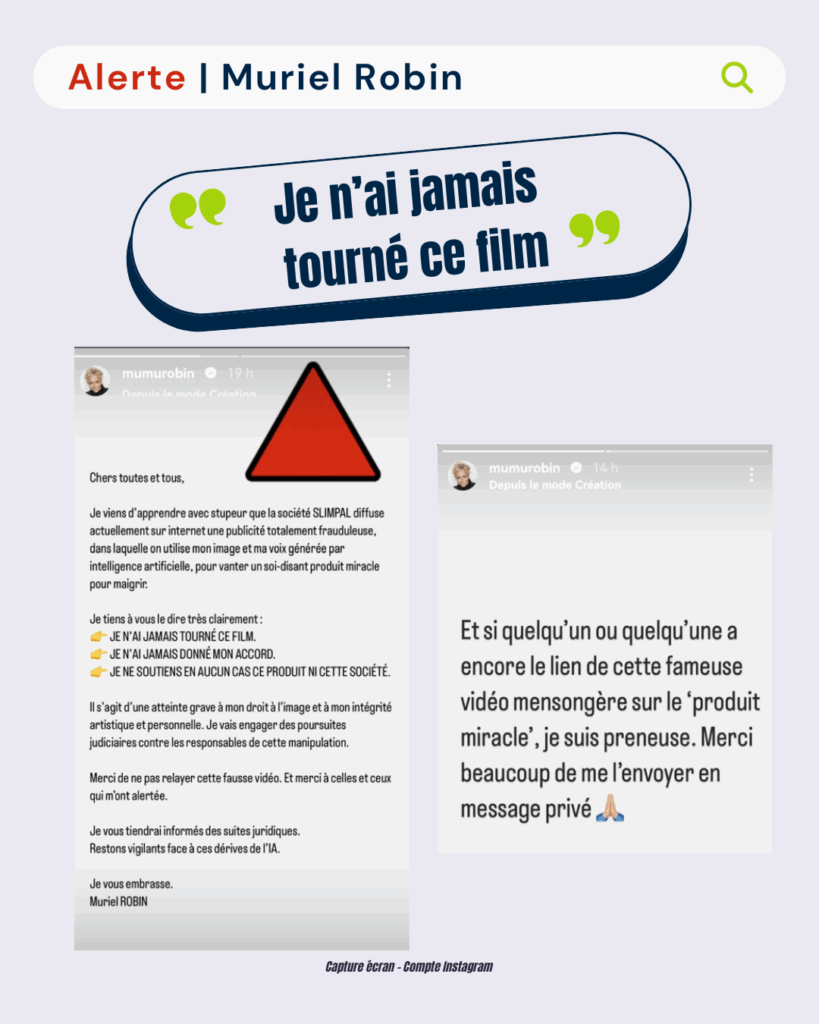
Unlike other celebrities who may have ignored or downplayed the phenomenon, Muriel Robin chose to respond publicly and firmly. She denounced these abuses to her fans, alerted the media, and filed a criminal complaint.
The Facts: What Fraudulent Content Circulated in Muriel Robin’s Name?
Misleading advertisements targeting vulnerable audiences
The deepfakes using Muriel Robin’s image primarily took the form of sponsored video ads distributed on Meta social networks (Facebook and Instagram). In these clips, the comedian appeared to enthusiastically endorse a variety of products: dietary supplements promising rapid weight loss, oils or creams with unproven therapeutic properties, and in some cases, automated online investment platforms.
The ad targeting of these fraudulent contents was precise: women aged 45 and over, with interests related to health, wellness, and culture, a demographic profile in which Muriel Robin enjoys particularly strong recognition and affection, and that was no coincidence.
Muriel Robin’s public response
Faced with these abuses, Muriel Robin did not wait for the phenomenon to die down on its own. She spoke out publicly to warn her fans, making it clear that she does not endorse any product on social media, and that any video showing her promoting a product or a financial investment is necessarily a fake. She also announced that she had filed a criminal complaint.
Context: A Deepfake “Epidemic”
An accelerating trend
Muriel Robin’s case is not isolated. In France, many public figures have fallen victim to similar abuses: Cyprien, Florent Pagny, Karine Le Marchand, Stéphane Plaza, as well as political figures such as Emmanuel Macron and business leaders like Bernard Arnault. Internationally, figures like Elon Musk, Taylor Swift, and King Charles III have been the subject of large-scale deepfake campaigns.
According to the State of Deepfakes 2023 report published by cybersecurity firm Home Security Heroes, the number of deepfake videos in circulation worldwide increased by 550% between 2019 and 2023, a progression that primarily reflects the explosion of non-consensual sexual content, which accounts for 98% of total deepfake production. At the same time, fraudulent uses for financial scams, fake advertising, and political disinformation represent a growing and well-documented share of deepfake-related incidents.
Available Legal Remedies
Filing a criminal complaint
By filing a criminal complaint, Muriel Robin initiated a legal process that can involve several overlapping charges: identity theft, infringement of image rights and privacy, aggravated fraud, false advertising, and misleading commercial practices.
Parallel legal avenues
In addition to the criminal complaint, several parallel steps can be considered, including:
- Formal notice to platforms via a bailiff, demanding immediate removal of fraudulent content under penalty of daily fines.
- Reporting to ARCOM (the French Audiovisual and Digital Communications Regulatory Authority).
- Application to a summary judgment court (juge des référés).
- Action with the CNIL if biometric data was processed without consent
The challenge of identifying perpetrators
The main difficulty in legal proceedings in these cases remains identifying the perpetrators. The networks that produce and distribute these deepfakes operate behind VPNs, relay servers, and offshore hosting structures.
Conclusion
By choosing not to stay silent, Muriel Robin accomplished far more than a personal legal step. She shed light on a phenomenon affecting thousands of public figures, whose direct victims, the people who are defrauded, are often the most vulnerable.
But effective resistance against deepfakes cannot rest on individual courage alone. It requires appropriate technological tools, a clear legal framework, and certification solutions capable of establishing irrefutable proof of authenticity.
The protection of digital identity has become, in 2025, just as fundamental as the protection of physical identity. To find out how to anticipate and protect yourself against image misappropriation, explore the Certiphy.io certification solution. And to stay up to date on deepfakes and content cybersecurity, visit our analyses and insights regularly.
📲 See the original post on our Instagram account: Hacked! Episode #7